
The Face at the Moment of Impact: The Performances of Closer

Directed by Mike Nichols
Mike Nichols’s Closer begins with a collision. Alice and Dan see each other across a London street, Damien Rice rises on the soundtrack, and what resembles romantic destiny ends with her body hitting the pavement. The moment becomes a warning: in this film, attraction and injury are never far apart.
Patrick Marber’s screenplay is built like an emotional torture chamber. Four people - Alice, Dan, Anna, and Larry, exchange lovers, lies, confessions, and humiliations, each believing that the truth will set them free when what they really want is the power to make somebody else hurt. Yet Closer would be little more than a cruel theatrical exercise without its actors. Natalie Portman, Jude Law, Julia Roberts, and Clive Owen make its calculated structure feel frighteningly immediate. Their performances are so exposed, so emotionally exact, that watching certain scenes unfold feels less like observing heartbreak than receiving a gut punch.
Jude Law’s Dan is perhaps the film’s most quietly damning performance. Law uses his beauty as part of the character’s moral disguise. Dan looks sensitive; he speaks softly; he writes novels and appears to understand suffering. But beneath that tenderness is an almost bottomless self-absorption. Law allows us to see the tiny shift whenever Dan’s concern for another person turns into panic about himself. He does not simply want to be loved—he needs to remain the tragic centre of everyone else’s life.
This makes Dan’s scenes with Alice almost unbearable. When he admits that he is leaving her for Anna, Portman’s face seems to collapse before she permits her body to do the same. Alice asks questions whose answers she already understands, as though forcing Dan to say the words might make the situation comprehensible. Portman does not play the scene as a conventional explosion. She becomes smaller. Her voice thins; her eyes harden; every pause suggests an effort to preserve the last fragment of her dignity. Then comes the pleading, and the humiliation of pleading in front of someone who has already emotionally departed. It hurts because Portman gives us the precise instant at which love becomes self-abandonment.
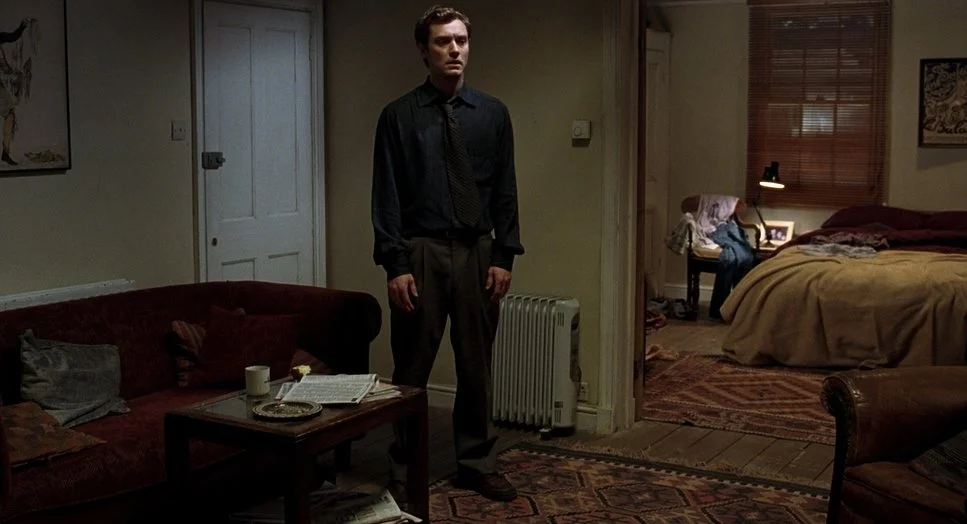
Alice is the film’s most elusive character, and Portman understands that vulnerability can itself be a disguise. She appears completely exposed while withholding the deepest part of herself. In the strip-club sequence with Larry, she turns performance into armor. Her body is available for display, but her identity is not. Larry demands her real name, and she repeatedly answers “Jane,” telling him the truth in a context where he is incapable of believing it. Portman’s brilliance lies in the contradiction: Alice can look fragile while remaining psychologically unreachable. The men see her naked and still fail to see her.
Clive Owen gives the film its most volcanic performance. Larry is vulgar, possessive, perceptive, and terrifyingly alive. Owen never asks us to confuse emotional directness with moral honesty. Larry says what the others suppress, but he often tells the truth for the same reason another person might throw a punch. When Anna confesses her affair, his questions become increasingly explicit. He insists that he needs details, yet Owen makes it clear that knowledge is not the point. He is searching for the exact image that will hurt him most, so that he can force Anna to experience that pain with him.
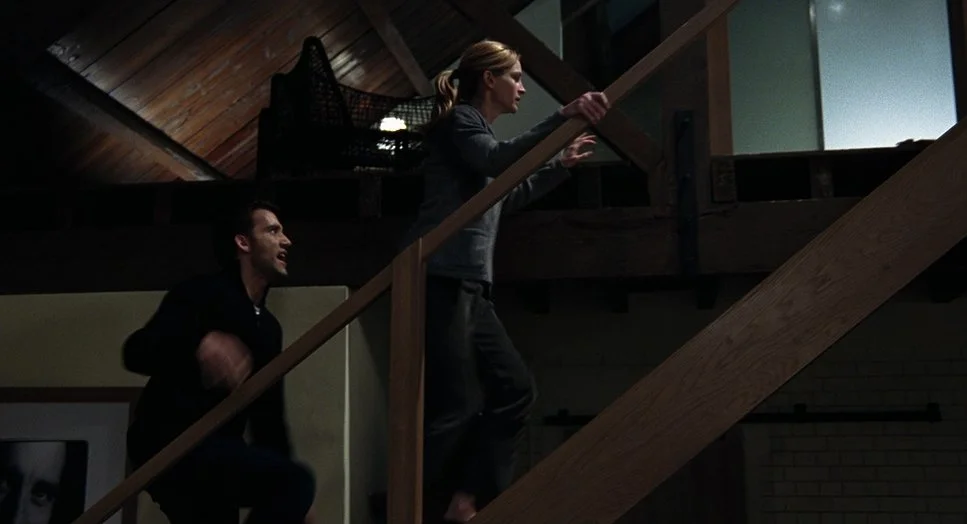
It is a brutal scene because Owen lets rage and devastation occupy the same body. Larry is monstrous, but he is also shattered. His cruelty does not conceal his vulnerability; it grows directly from it. Every obscene question is both an attack and a desperate demand to know whether he ever mattered. Owen’s performance denies us the safety of simple judgment. We recoil from Larry even as we recognize the wounded terror beneath his aggression.
Julia Roberts gives the film its quietest performance, and perhaps its most underestimated. Anna is often accused of passivity, but Roberts turns that passivity into a form of paralysis. She seems permanently braced for the consequences of decisions she cannot stop making. Her restraint is crucial against Owen’s force. During Larry’s interrogation, she barely moves, yet her stillness feels violent: the shame sits in her posture, in her lowered eyes, in the exhaustion of someone who knows that every answer will become another weapon. Roberts refuses to transform Anna into either a romantic victim or a calculating seductress. She plays her as a person whose desire is stronger than her capacity to take responsibility for it.
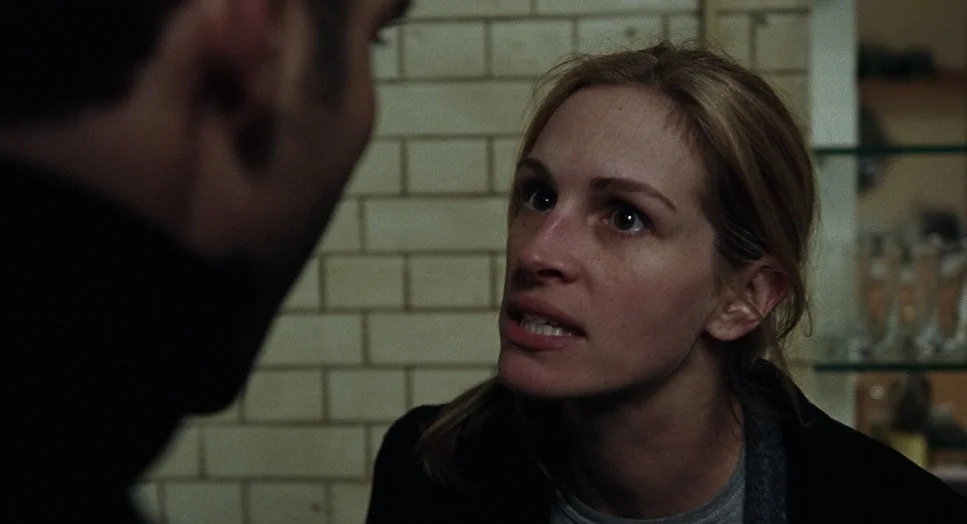
Together, the actors make language feel physical. Closer contains little conventional action, but its conversations have the impact of fight scenes. A look arrives like a slap. A pause becomes an act of abandonment. Nichols holds on faces after the decisive sentence has been spoken, allowing us to watch the wound register. The most painful moments are often not the declarations themselves but the silence immediately afterward, when a character realizes that nothing can be taken back.
The theatricality of Marber’s dialogue occasionally shows. People speak in polished cruelties, as if heartbreak has given them time to prepare perfect lines. But the performances transform that artificiality into ritual. These characters are not speaking naturally because they are no longer trying to communicate; they are performing versions of themselves—innocent, betrayed, desirable, invulnerable—while waiting to see which performance will win.
No one wins. Dan’s final confrontation with Alice is devastating because Portman removes nearly everything from her voice when she tells him she no longer loves him. Dan cannot accept the statement without demanding an explanation. He still believes that access to her feelings is his right. When he strikes her, the violence does not feel like a sudden departure from the film’s emotional world. It is merely the physical expression of the entitlement that has always been present.
By the end, Dan discovers that Alice was really Jane Jones. He had written about her, lived with her, betrayed her, and begged for her return without ever knowing her name. Law plays the realization without grandeur. There is no revelation that can redeem him, only the humiliating knowledge that the woman he claimed to love remained a stranger.
That is where the performances in Closer hurt most. These actors do not merely portray people falling out of love; they expose the panic, vanity, and degradation hidden inside the desire to be chosen. They make us watch affection curdle into ownership and honesty become punishment. The film leaves bruises because its cruelty never feels abstract. It lives in four faces, each waiting for mercy and choosing, again and again, to wound instead.